Wiser investment of highways maintenance funding will see more
of the road network treated, reduce the number of potholes and
improve future ratings for local highway authorities.
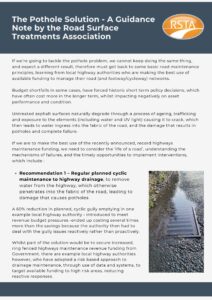
The Pothole Solution – A guidance note by the Road Surface Treatments Association
As demonstrated below, increases in percentages of network treated with surface
treatments could make a huge difference on the road network and change ratings
from red to amber, or amber to green, much quicker.
This is following the report published by the Government this week, rating local
highway authority performance, which seeks to understand how maintenance
funding is being invested; identifying opportunities to support authorities not adopting
good practice of preventative maintenance and permanent repair solutions. A move
welcomed by the RSTA.
The RAC reported last year that 3% of English local authority roads received any
form of road maintenance in 2023 (based on £1.1billion capital maintenance
funding).
Adopting a 50/50 split for example, of preventive treatments and recycling / end of
life resurfacing, (assuming 75% investment of the £1.6billion funding for 2026/27
going into road maintenance), could see up to 7% of roads treated in 2026/27, rising
to 9% by 2029/30 (when Government maintenance funding rises to £2.134billion).
The RSTA has produced a guidance note with four key recommendations, to
highlight the opportunities of returning to some core road maintenance and asset
management principles. These are:
•Investing in essential highway drainage maintenance activities to remove
water from the highway, which can otherwise result in water penetrating the road
surface, leading to potholes.
•Investing in timely and cost effective preventative maintenance treatments
to seal roads and prevent water ingress, extending road life and preventing potholes
• Permanent patch repair solutions (even if this is a follow up to temporary
safety repairs), embracing technologies to identify priority areas, supporting a longer
term, cost effective and planned approach
• Cold recycling end of life, crumbling, heavily potholed roads, using
materials already bought and paid for, to form the construction of the replacement
road.
If maintenance strategies incorporated these recommendations, as some local
highway authorities already do, we could see a significantly larger proportion of the
network treated by 2029/20, which will undoubtedly see a declining trend in the
number of reactive potholes being repaired, said the RSTA.
Significantly more roads could be treated using preventative road surface
treatments, which would serve to manage roads in better condition, and prevent
future potholes, lowering longer term costs.
Some local highway authorities report roads that have gone beyond preventative
maintenance and are now approaching or have reached end of life and are
prohibitively expensive to repair. Some local authorities are adopting methods of cost
effective cold recycling options of these roads, utilising materials already bought and
paid for, to form the construction of the new road.
Mike Hansford, Chief Executive of the RSTA said “At the start of my highway
maintenance career, I recall experienced engineers discussing core road
maintenance principles of (1) maintaining highway drainage to remove water from
the highway, and (2) sealing roads early to stop the damaging effects of water
ingress.”
“Yet industry data suggests a historic departure from preventative treatments, and
reduced cyclic drainage maintenance activity, so its important we get back to these
core maintenance principles. “
“Challenging budgets (especially revenue funding) in some cases have forced short
term policy decisions to save money, which have subsequently impacted negatively
on highway asset condition and performance, even resulting in increased reactive
interventions, therefore have cost more in the longer term. “
“I have seen the effects of multiple temporary and expensive safety repairs to the
same defective area, when a single planned, permanent repair would cost only a
third of that cost and been better perceived by the public. Permanent patch repairs
typically, will last a minimum of 5-6 years, though will likely be guaranteed for 12-18
months by which time any poor reinstatements will likely start to fail.”
The media coverage of the pothole problem, and the fact we have a ‘National
Pothole Day‘ at all, suggests the current approach isn’t working, and we cannot
continue to do the same things and expect a different outcome. Therefore we have
to promote good practice being carried out by some exemplar authorities, and
present learning opportunities to share these experiences.
Whilst there’s been some negativity reported in the industry media; we must
acknowledge that the transparency reporting is the Government’s first stab at
understanding how local highway authorities are investing their maintenance
funding, which is intended to identify opportunities to support those who are not
investing in preventative maintenance and longer term, permanent repair solutions.
RAC head of policy Simon Williams said: “Fixing potholes as permanently as
possible is vital as there’s nothing drivers find more incensing than watching them
reappear after a few months simply because they weren’t repaired to a high enough
standard.
“But it’s important not to lose sight of the bigger picture which is that potholes are
symptomatic of a lack of preventative maintenance. Roads that haven’t been
surfaced dressed will start to break down as water gets into cracks, freezes and
expands in the winter creating more potholes than daffodils in the spring.
“The route to smoother driving surfaces is simple: ensure water can always drain off
the roads, fix potholes as permanently as possible, seal roads against water ingress
through preventative maintenance, and resurface roads that have gone beyond the
point of no return.
“If we continue to obsess with just filling potholes, that’s all we’ll continue to get.”
The RSTA remains committed to supporting the Department for Transport and local
highway authorities, and 2026 will see a number of free to local highway authority
events which present learning opportunities.
Starting with the RSTA’s annual conference on the 16th April, which will focus on
celebrating and sharing good practice, and we would encourage local highway
authorities to consider registering their interest in attending as guests of the RSTA by
emailing [email protected]